


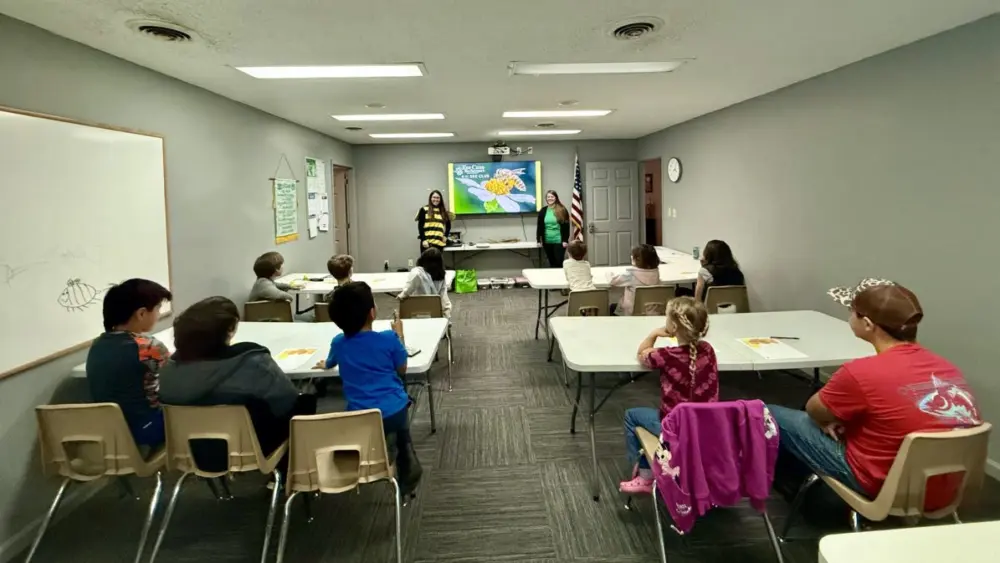
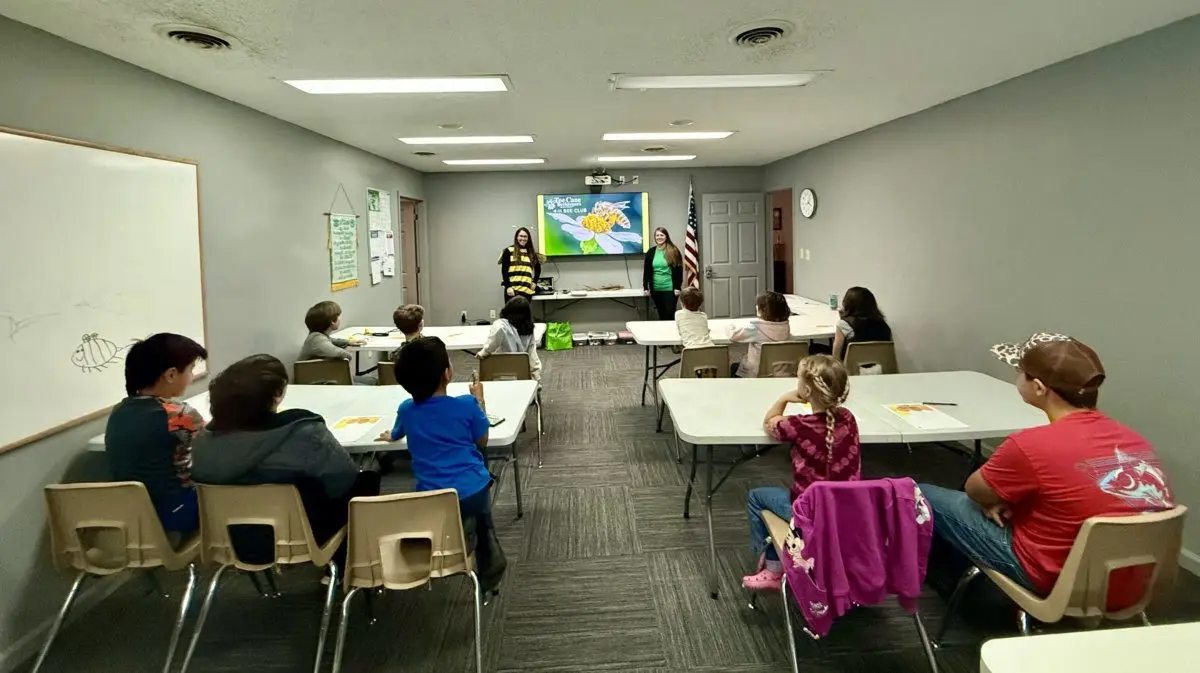
Ten local 4-H members ages 5 to 18 attended the first meeting of the Yancey County 4-H Bee Club on March 19 at the Yancey County Extension office, where they learned about bee biology and how to distinguish honey bees from bumblebees, hornets, yellow jackets, and other wasps.
“There is a tendency to consider any stinging insect with wings a ‘bee,’” said Camille Collins, vice president of the Toe Cane Beekeepers Association (TCBA), who led the meeting. “But anyone going into farming or other agricultural services should know the difference between a beneficial pollinator and their less-friendly cousins.”
Club participants learned bees are rounder and fuzzier than wasps or hornets, with hair-like structures that help them collect pollen. They tend to have muted colors—golden yellows and browns—and are generally nonaggressive. You’ll often find them moving methodically from flower to flower, playing a critical role in pollination. This is especially important for growers of vegetables, fruits, and nuts.
Wasps, on the other hand, have slender, smooth bodies with a more defined “waist.” Their coloring is usually brighter, with yellow jackets having a bold yellow-and-black pattern. Unlike bees, wasps are predators and scavengers, feeding on insects and human food alike. As anyone who has stumbled across an underground nest can tell you, wasps are more aggressive than bees and can sting multiple times, especially if they feel their nest is in danger. Honey bees, on the other hand, do not live underground and will die after stinging humans and other mammals just once.
The largest and most robust members of the wasp family are known as hornets. In this area, they often have white or pale markings mixed with dark brown or black bodies, rather than the bright yellow of typical wasps. Hornets build large, paper-like nests, often in trees or under eaves, and can be particularly defensive if disturbed.
More Activities Planned
The Yancey County 4-H Bee Club meets monthly on the 3rd Thursday at 4 pm. Contact the Yancey County Extension Office to participate, jazlyn_swain@ncsu.edu. Adults who would like to volunteer should contact the TCBA. Volunteers are needed in Yancey, Mitchell, and Avery counties.
At an upcoming meeting, the 4-H Bee Club participants will visit the TCBA Educational Apiary at Mayland for some hands-on beekeeping. Currently home to seven beehives, the education apiary allows new beekeepers of any age to get up close and personal with bees and gain experience working with bees before they invest in their own hive. The 4-H class will see how a bee starts as an egg, becomes a larva and then a pupa before emerging as an adult.
Teachers and youth leaders who would like to schedule a visit to the apiary are encouraged to contact TCBA at beek@toecanebeekeepers.net.
The Toe Cane Beekeepers Association is a 501(c)(3) tax-exempt nonprofit promoting sustainable beekeeping practices in Mitchell, Avery, and Yancey counties. The association supports the beekeeping community by encouraging cooperation among local beekeepers and through hands-on training, mentoring, guest speakers, and classroom lectures. Visit www.toecanebeekeepers.net for more information.