


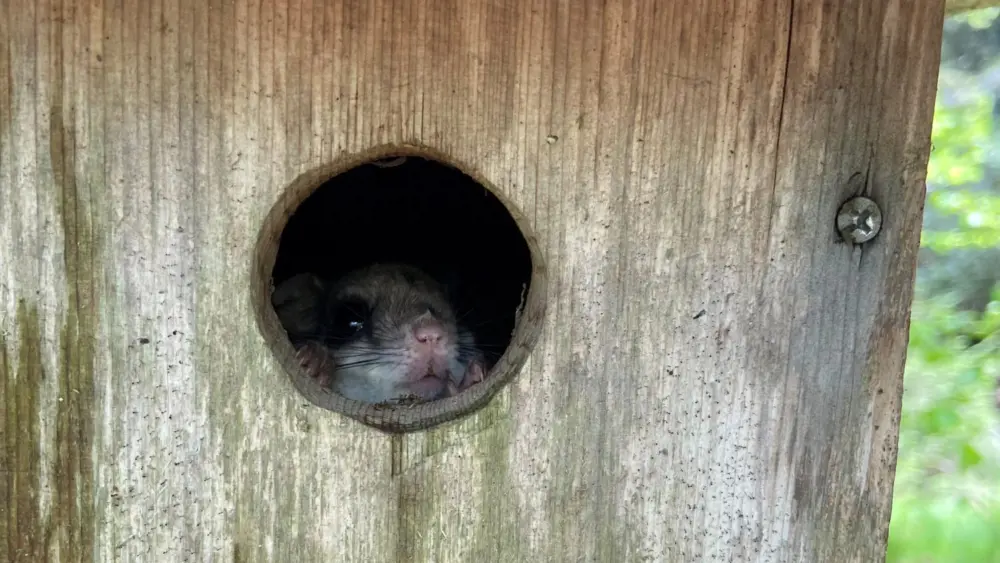
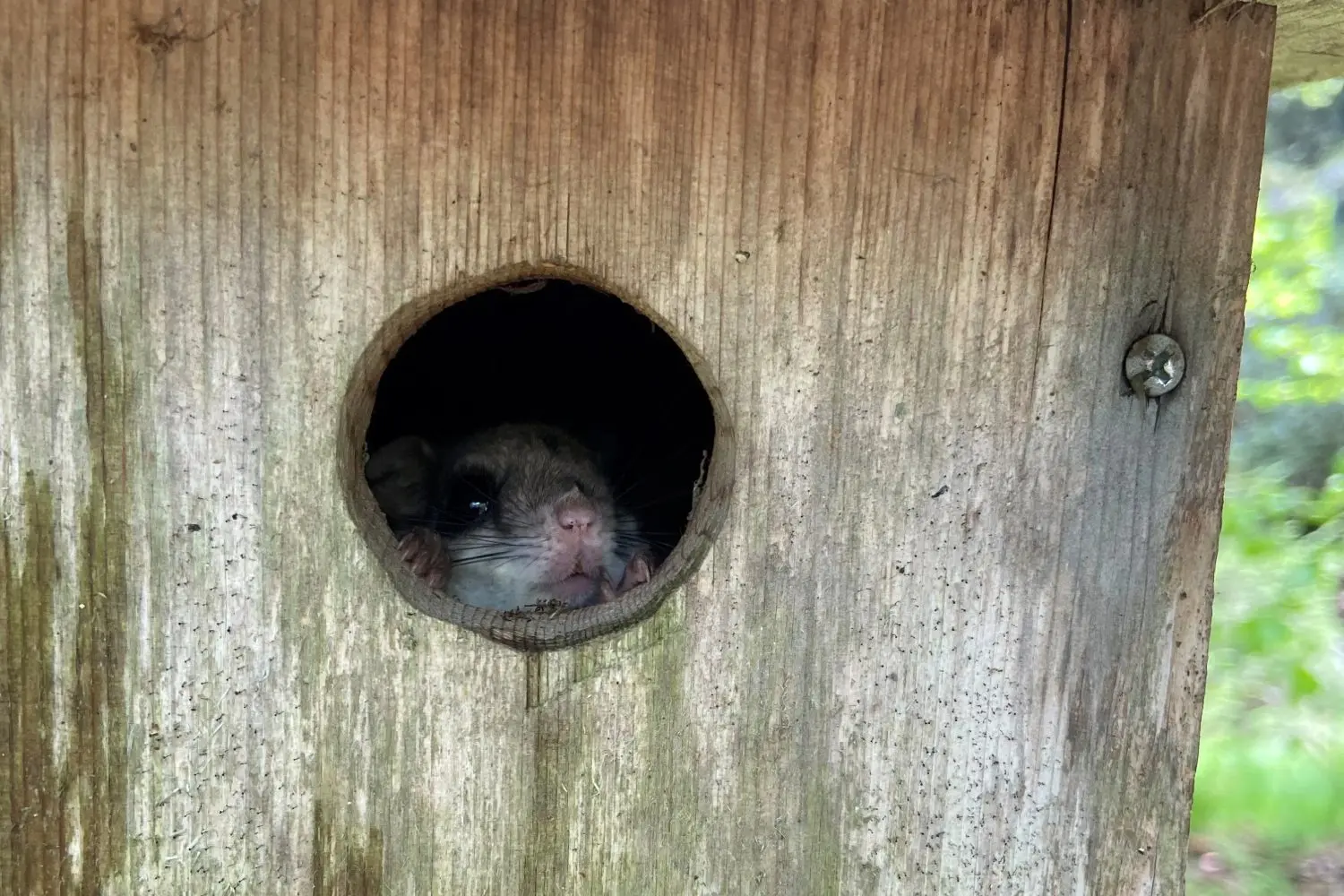
Grandfather Mountain, the not-for-profit nature park run by the Grandfather Mountain Stewardship Foundation, partnered with the N.C. Wildlife Resources Commission and the N.C. Division of Parks and Recreation in February to conduct their annual population count of one of North Carolina’s endangered species found on Grandfather Mountain: the Carolina northern flying squirrel.

During the Wildlife Commission’s study, the state agency was able to identify eight Carolina northern flying squirrels and one Southern flying squirrel using a series of nest boxes along a transect line located in both the Grandfather Mountain nature park and Grandfather Mountain State Park. The researchers monitor trends in the flying squirrel population that exists on the mountain based on the squirrels they find in their studies. They then use this data to examine trends in occupancy over time.
Currently, up-to-date monitoring data is not available to the public. However, Will Bennett, research coordinator for the Grandfather Mountain Stewardship Foundation, said that it is typical to find six to 10 squirrels on average during these studies.
“From what we have seen, the Carolina northern flying squirrel population at Grandfather Mountain has remained stable over the past few years,” Bennett said.
The number of squirrels detected annually has varied throughout the study. This is due in part to the fact that northern flying squirrels have multiple den sites and may not be using a nest box on the day of the survey. Biologists suspect many factors influence use of boxes, including recent weather and food availability.
Imperfect detection of a rare, elusive, nocturnal species often requires multiple survey and monitoring techniques. NCWRC biologists supplement the nest box monitoring with acoustic monitoring that uses an automated recording unit to record the vocalizations of flying squirrels.
As part of the winter nest box monitoring, researchers gently coax the squirrel out of a nest box, which the squirrels use for denning and rearing their young, and into a mesh bag. They then measure the squirrel’s hindfoot length to verify if it is a Carolina northern flying squirrel, whose feet are longer than the more common southern flying squirrel. Biologists also examine the color of the squirrel’s tail, which indicates its age, and they also verify its weight, sex and reproductive condition.
The range of the northern species is restricted to high-elevation forests, while southern flying squirrels are more commonly found in lower elevations. Northern flying squirrels have bright cinnamon-brown colored fur and a cape of loose skin that stretches from their wrists to ankles, allowing them the ability to glide through the air. Other features that set the northern flying squirrel apart include bicolored belly hairs (gray and white) and the fact that these squirrels weigh nearly twice as much as their southern counterparts.
As a distinct sub-species of the more commonly found northern flying squirrel, which thrives in the boreal forests of Canada, the Carolina northern flying squirrel is a species that plays a critical role in determining the health of its environment. These squirrels are known as an indicator species, meaning that the health of this population of squirrels corresponds with the health of the forest as a whole.
“These surveys are critical in understanding our spruce-fir forests, which are the second most endangered ecosystem in the U.S.,” Bennett said. “If something is happening in the flying squirrels’ habitat to change their population numbers, such as an invasive species or intense food source competition, the annual count will bring that to our attention.”
The Carolina northern flying squirrel helps create its own forest habitat. Unlike other species of squirrel that help populate the forests’ trees and other plants by burying acorns and seeds, the Carolina northern flying squirrel does so by primarily feeding on and spreading truffles, a type of fungi that is found on the roots of trees.
These fungi are a critical organism that trees use as a source of water, while the fungi use the trees as a source of sugar. As squirrels eat the outer shell of the truffle, they inadvertently consume and then pass undigested spores from the truffle throughout the forest.
As an endangered species, the Carolina northern flying squirrel has been studied at Grandfather Mountain since the 1990s. The species was first discovered in North Carolina in the 1950s and later listed as federally endangered in 1985. The Carolina northern flying squirrel is only found in nine locations throughout Western North Carolina, Eastern Tennessee and Southwest Virginia.
The species was identified at Grandfather Mountain once research expanded beyond Mt. Mitchell, Roan Mountain and the Great Smoky Mountains after it was classified endangered. Ever since, staff from Grandfather Mountain and Grandfather Mountain State Park have assisted in research.
To learn more about the endangered species that exist on Grandfather Mountain, visit www.grandfather.com/
The nonprofit Grandfather Mountain Stewardship Foundation strives to inspire conservation of the natural world through education, exploration and example. For more information, visit www.grandfather.com.
###
Captions:
GMSF_Flying Squirrel Survey_Nest Box_Photo Courtesy of Grandfather Mountain Stewardship Foundation: Grandfather Mountain, the not-for-profit nature park run by the Grandfather Mountain Stewardship Foundation, partnered with the N.C. Wildlife Resources Commission and N.C. Division of Parks and Recreation in February to conduct their annual population count of one of North Carolina’s endangered species found on Grandfather Mountain: the Carolina northern flying squirrel. (Photo Courtesy of Grandfather Mountain Stewardship Foundation)
GMSF_Flying Squirrel Survey_Trail_Photo Courtesy of Grandfather Mountain Stewardship Foundation: During the N.C. Wildlife Commission’s study at Grandfather Mountain, the state agency was able to identify eight Carolina northern flying squirrels and one Southern flying squirrel using a series of nest boxes along a transect line. The researchers monitor trends in presence of flying squirrels that exist on the mountain based on the squirrels they find in their studies. They then use this data to examine trends in occupancy over time. (Photo Courtesy of Grandfather Mountain Stewardship Foundation)
GMSF_Flying Squirrel Survey_Squirrel_Photo Courtesy of Grandfather Mountain Stewardship Foundation: As a distinct sub-species of the more commonly found northern flying squirrel, which thrives in the boreal forests of Canada, the Carolina northern flying squirrel is a species that plays a critical role in determining the health of its environment. These squirrels are known as an indicator species, meaning that the health of this population of squirrels corresponds with the health of the forest as a whole. (Photo Courtesy of Grandfather Mountain Stewardship F